Reach the scalp
A prescribed solution, foam or lotion can be easier to apply through hair. Ask exactly where and how long to use it.
How can I ease the itch? →A guide for adults & their families
Clear answers. Practical care.
A plan you can build with your care team.
Start here if your main concerns are skin changes or an itchy scalp—even when your muscles feel strong.
Small steps, meaningful relief
Bring the symptoms that bother you most into the conversation.
A prescribed solution, foam or lotion can be easier to apply through hair. Ask exactly where and how long to use it.
How can I ease the itch? →Facial and eyelid skin need site-specific treatment. Check before using a scalp medicine on your face.
Which creams go where? →Choose SPF 50+, a hat, clothing and shade. A routine you can keep up is a useful part of care.
Everyday care questions →The questions you may be asking
Open an answer. Follow its sources if you want to read more.
Dermatomyositis (DM) is an autoimmune condition: immune activity causes inflammation in the skin and sometimes the muscles. It is not contagious. Some people mainly have skin symptoms; others develop weakness, especially around the shoulders and hips.
Read the evidence: Dermatomyositis: patient information · Guideline for managing inflammatory myopathy
Yes. Your clinician may describe a skin-predominant form. The term clinically amyopathic dermatomyositis is used after assessment and observation over time. Feeling strong is reassuring, but examination and blood tests still matter. Normal muscle blood tests do not describe lung health.
Read the evidence: Treatment of clinically amyopathic dermatomyositis · Screening and monitoring for lung involvement · Classification of inflammatory myopathy
Your team reviews the rash, its distribution, your history and any biopsy or blood results. Scalp inflammation can resemble dandruff-related dermatitis or psoriasis. A skin biopsy can help when the diagnosis is uncertain, but it must be interpreted with the examination. Classification criteria help organize findings; they are not a substitute for a clinical diagnosis.
Read the evidence: Scalp involvement can resemble other skin conditions · Classification of inflammatory myopathy
Rashes may affect the eyelids, knuckles, scalp, nail edges or sun-exposed chest and back. Colour can be red, purple, brown or subtle, depending on skin tone. An itchy scalp can be troublesome even when the visible rash seems mild. The optional photographs below show examples, not a test of your diagnosis.
Read the evidence: Photographic guide to skin findings · Scalp involvement can resemble other skin conditions
Ask for a treatment that reaches the scalp, such as a prescribed anti-inflammatory solution, foam or lotion. Your clinician chooses the strength, course length and maintenance plan. If dandruff-related dermatitis is also present, an antifungal shampoo may help that part of the problem.
Use gentle, fragrance-free products and avoid products that sting or trigger irritation. Cool compresses may give temporary comfort. Tell your team if itching interrupts sleep or continues despite treatment: controlling inflammation may require a different treatment. Evidence for scalp-specific DM treatments is limited.
Read the evidence: Scalp involvement can resemble other skin conditions · Guideline for managing inflammatory myopathy · Systemic treatment of skin-only dermatomyositis
Only if your prescriber specifically directs it. Facial and eyelid skin need a separate plan. Options may include a brief course of an appropriate topical steroid or a steroid-sparing cream such as tacrolimus. Ask where to apply each product, for how long, and what to do when the rash returns.
Read the evidence: Guideline for managing inflammatory myopathy
Sunlight can worsen the rash. Use broad-spectrum SPF 50 or higher, protective clothing, a hat and shade. Reapply sunscreen every two hours outdoors and after swimming or heavy sweating. Continue comfortable activity; ask about tailored exercise if weakness develops. Report changes rather than changing prescribed medicines yourself.
Read the evidence: Dermatomyositis: patient information · Guideline for managing inflammatory myopathy
The first steps usually include a skin and strength examination, muscle blood tests such as CK and sometimes aldolase, and selected antibodies. Antibodies help describe the pattern and guide further checks; a result alone does not establish a diagnosis.
Muscle MRI, electrical testing or muscle biopsy may help if the findings are unclear. Everyone does not need every test. Ask what each proposed test would change about your care.
Read the evidence: Classification of inflammatory myopathy · Guideline for managing inflammatory myopathy
Lung inflammation can occur without muscle weakness. Your team may arrange breathing tests, including a measure of oxygen transfer called DLCO, and a high-resolution chest CT. Certain antibodies, including MDA5 and antisynthetase antibodies, make timely assessment especially important. Report a new cough or breathlessness promptly rather than waiting for a routine appointment.
Read the evidence: Screening and monitoring for lung involvement
Adult dermatomyositis is associated with a higher chance of some cancers. Screening is a precaution; the diagnosis does not mean you have cancer. Your plan considers age at symptom onset, disease type, antibodies, symptoms and previous screening.
Keep routine screening up to date. Some people need additional tests around diagnosis. PET scans and repeated whole-body CT scans are not required for everyone. Ask your team to explain your risk category and follow-up plan.
Read the evidence: Risk-based cancer screening in myositis
HCQ can be considered when skin symptoms persist despite topical care and sun protection. It helps some people but may not control DM skin disease by itself. It is not a treatment for significant muscle or lung inflammation.
It takes weeks to assess benefit. Your clinician sets a review point, often around two to three months if symptoms are stable. A new or suddenly worse rash after starting HCQ may be a medication reaction: contact your prescriber rather than assuming it is a flare. Arrange baseline eye screening and follow the recommended monitoring schedule.
Read the evidence: Systemic treatment of skin-only dermatomyositis · Treatment of clinically amyopathic dermatomyositis · Eye screening for hydroxychloroquine
MTX may be considered for persistent or more extensive skin inflammation, disabling itch, or when HCQ is ineffective or unsuitable. It can also treat inflammatory muscle disease. HCQ is not a required step before MTX; the choice depends on symptoms, other organ involvement and your health history.
MTX for inflammatory disease is taken once weekly, with a prescribed folic acid plan. Blood counts, liver and kidney tests are monitored. Discuss other medicines, alcohol, infections and pregnancy plans before starting. It takes weeks to work; full benefit may take up to 12 weeks.
Read the evidence: Systemic treatment of skin-only dermatomyositis · Treatment of clinically amyopathic dermatomyositis · Methotrexate: how it is taken and monitored · Guideline for managing inflammatory myopathy
Other options include mycophenolate, intravenous immunoglobulin (IVIG) and specialist treatments. The order is flexible. Lung, muscle or swallowing disease may need a different plan from isolated skin symptoms. Mild skin disease does not automatically require oral steroids. Many skin-treatment decisions rely on smaller studies and clinical experience rather than direct comparisons.
Read the evidence: Guideline for managing inflammatory myopathy · Systemic treatment of skin-only dermatomyositis · Treatment of clinically amyopathic dermatomyositis
The course varies. Some people reach remission; others need ongoing treatment or have flares. Follow-up checks both disease activity and medicine effects. Your own pattern over time is more useful than a single prediction. Ask what improvement should look like for your skin, itch and daily activities.
Read the evidence: Dermatomyositis: patient information · Guideline for managing inflammatory myopathy
Contact your care team promptly for a new cough, breathlessness, swallowing difficulty or weakness. Fever while taking immune-suppressing treatment also needs prompt advice. Severe breathing difficulty, chest pain, choking or inability to swallow liquids or saliva needs emergency assessment. Use your local emergency number; this website cannot assess symptoms or contact your team.
Read the evidence: Guideline for managing inflammatory myopathy · When breathlessness needs urgent help
No matching questions. Try a different word or choose “All questions”.
Understanding the choices
A conversation about your needs—not a fixed ladder.
May help when topical care is not enough. Some people need another medicine for good control.
Plan for eye screening and a review of benefit. Report a new rash after starting.
Read the HCQ answer →May suit troublesome itch or persistent inflammation, including when HCQ has not helped or is unsuitable.
Taken once weekly, with a folate and blood-test plan. It can also treat muscle inflammation.
Read the MTX answer →Read the evidence: Systemic treatment of skin-only dermatomyositis · Treatment of clinically amyopathic dermatomyositis · Methotrexate: how it is taken and monitored
Your next conversation
Print this page or use these questions at your appointment.
Published clinical photographs. These are examples from other people and do not show every skin tone or appearance. Your own rash may look different.
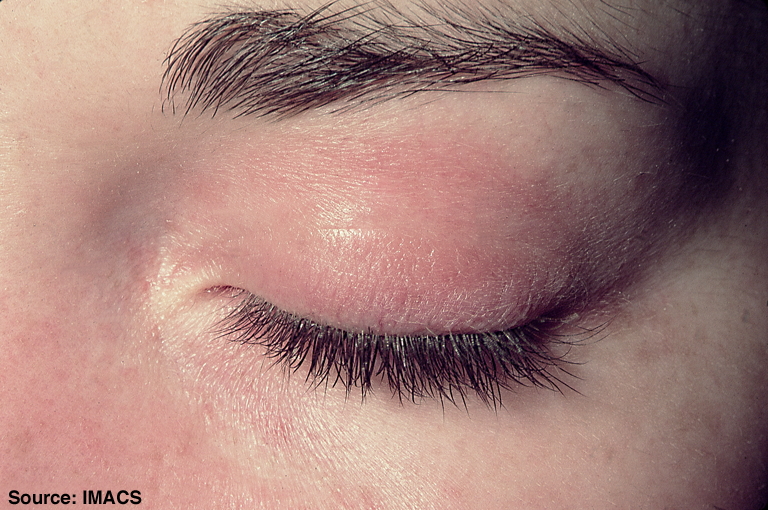
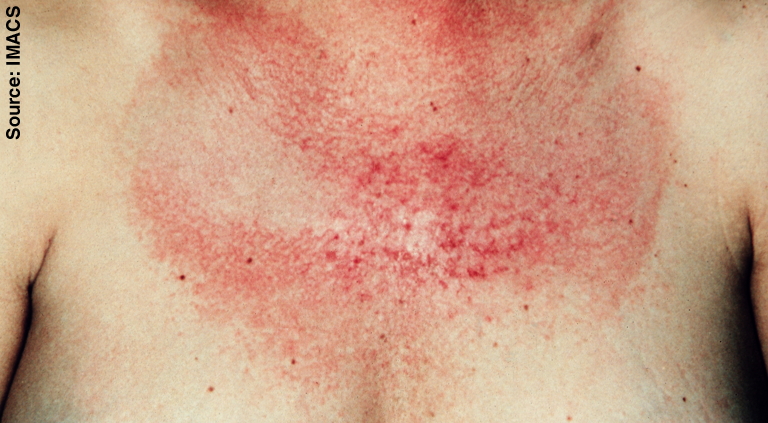
Photographs: Elizabeth M. Dugan, Adam M. Huber, Frederick W. Miller and Lisa G. Rider / IMACS. Original pixels and source marks preserved; displayed proportionally. Eyelid source · Chest source · CC BY-SA 3.0.
For curious minds
Start with the patient guides. Clinical guidelines and research papers offer more detail. Many treatment choices use smaller studies and expert guidance; they cannot predict one person’s response.

